

Project Location:
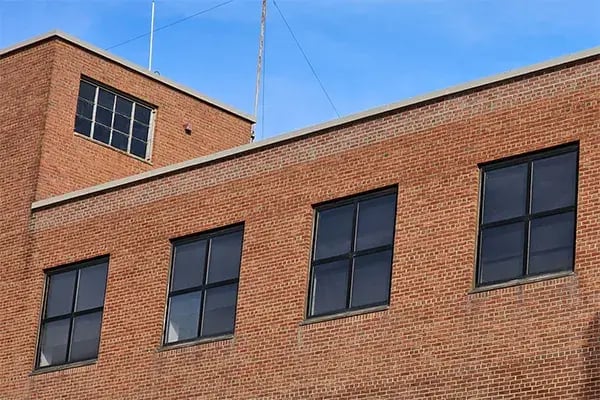
The project took place at an active research and development facility in the mid-Atlantic states of the US.
Pain Point:
Deteriorated capstones and failed joints allowed water to enter the parapet and wall assembly, accelerating further damage.
Project Challenge:
The client needed a durable, 25-year repair that avoided demolition, full-building scaffolding, suspected asbestos disturbance and unwanted changes to the building’s appearance.
Impact on Day-to-Day Operations:
Ongoing water intrusion threatened further deterioration, while conventional replacement would interfere with building access and normal research operations through extensive scaffolding, demolition and prolonged construction.
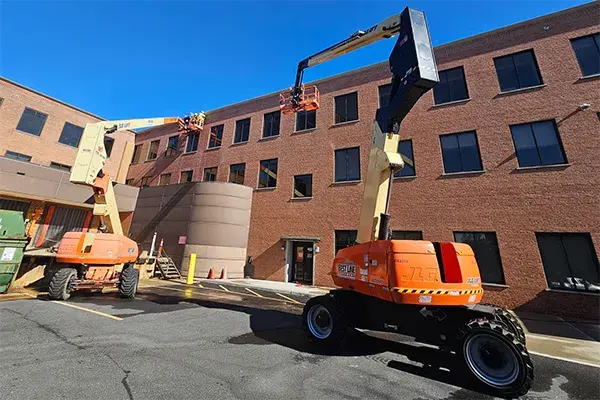
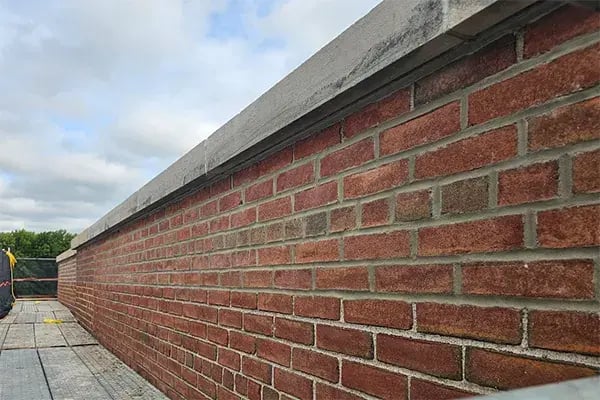
Brick repointing work was done largely from a MEWP, avoiding full-building scaffold.
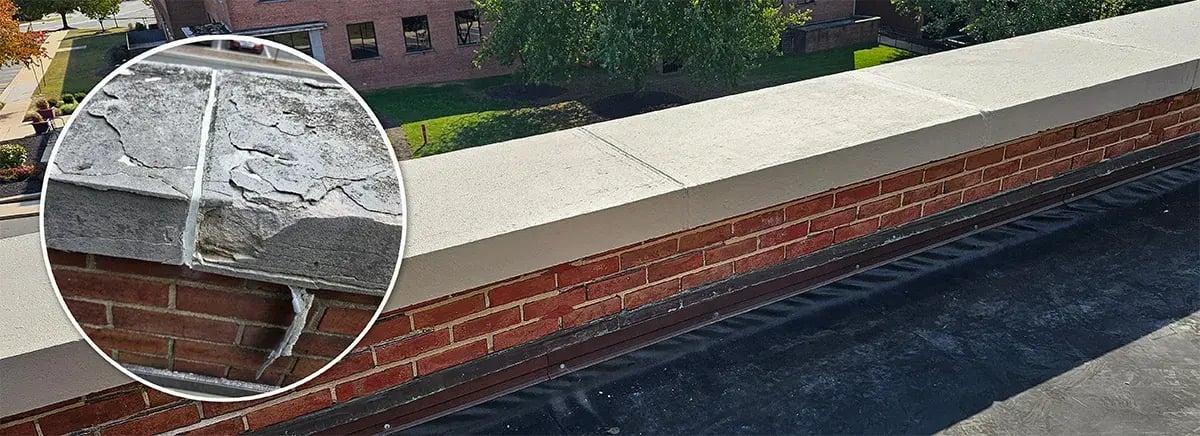
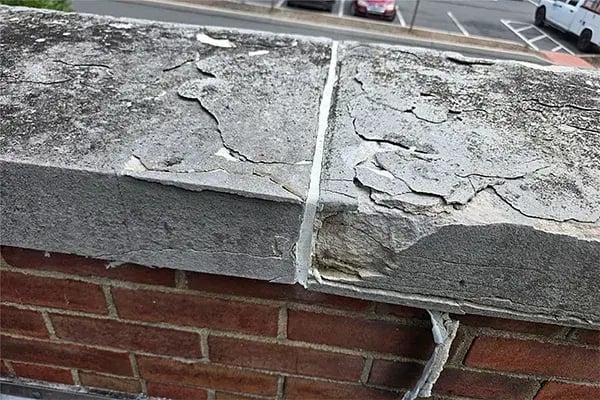
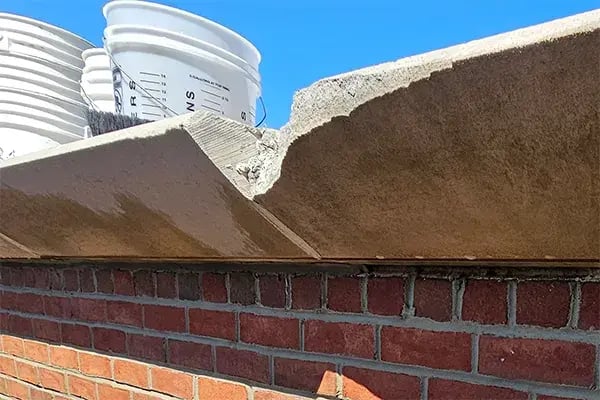
Decades of environmental exposure had deteriorated the cast concrete capstones crowning a three-story brick masonry building. Assessment of approximately 760 linear feet of parapet coping found widespread delamination, contour scaling, spalled material, full-unit cracks, biological growth and efflorescence.
Failed sealant and open joints provided direct paths for water into the parapet and wall assembly, where exposure caused water damage to the building interior. The client needed to stop the water intrusion, restore the capstones and achieve a minimum 25-year service life while maintaining an appearance consistent with other brick buildings on the campus.
Portions of the existing capstone bedding and joints contained asbestos material. This made avoiding unnecessary disturbance an important consideration in selecting the repair approach.
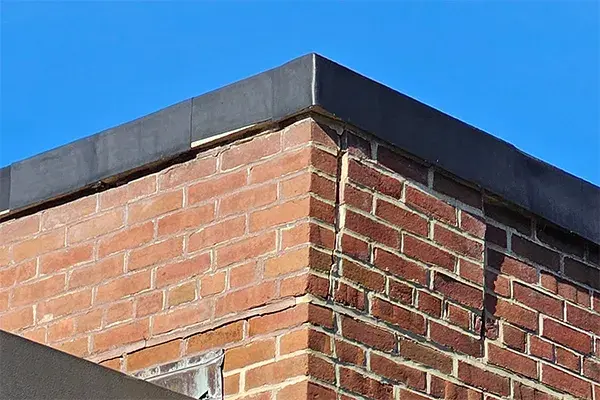
The conventional remedy required removing the capstones and installing aluminum coping. That solution necessitated full-perimeter scaffolding to remove and lower the heavy units, followed by handling, hauling and landfill disposal. Disturbing asbestos-containing materials would require abatement before reconstruction began.
In addition to increasing costs and labor, replacement would take considerably longer and interfere with normal use of the active research building. Aluminum coping could also alter the building’s appearance while concealing, rather than repairing, the deteriorated capstones.
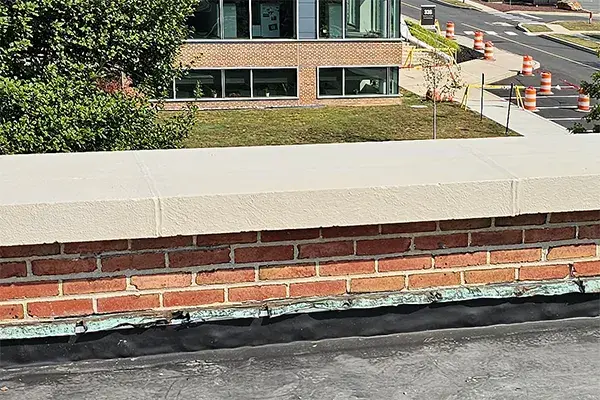
Example of aluminum coping fitted over a capstone parapet. This solution shields the capstone joints, but does not fix the underlying problem.
BIG developed an in-place rehabilitation of deteriorated concrete strategy that addressed the damage and water intrusion without demolishing the capstones. This approach reduced the project’s access, labor, disposal and abatement requirements while preserving the existing structure.
BIG crews cleaned the capstones, removed loose material and rebuilt damaged areas with Belzona 4141 Magma-Build. The repair composite could be applied without formwork and shaped to restore the original capstone profiles. Crews also replaced failed joint sealant and coordinated brick repointing with the capstone repairs.
BIG conditioned the restored surfaces with Belzona 3911 to promote adhesion. BIG then reinforced the joints and seams with Belzona 9311 Reinforcement Sheet embedded in Belzona 3111 Flexible Membrane before applying two complete membrane coats across the capstones.
This cold-applied, water-based system formed a continuous weatherproof barrier while allowing residual water vapor to escape. Its elasticity accommodated normal building movement, helping protect the repaired joints from renewed cracking and water entry. Low odor allowed BIG to perform the work during regular campus operations without hot work.
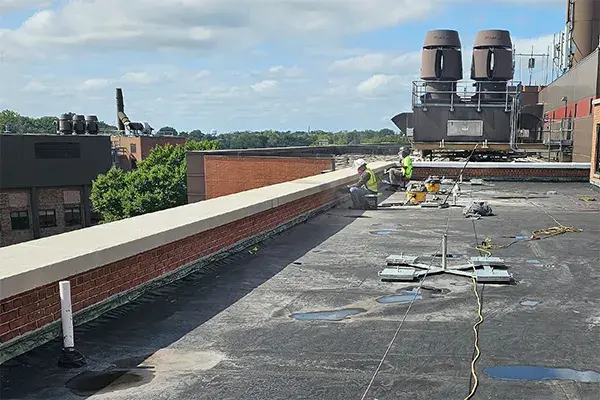
BIG planned the work around application temperatures and precipitation, completing the project in six weeks as weather conditions permitted. Crews worked primarily from the roof and mobile elevated work platforms (MEWPs). They used limited scaffolding only where required on the roof, eliminating the expense and disruption of full-building scaffold.
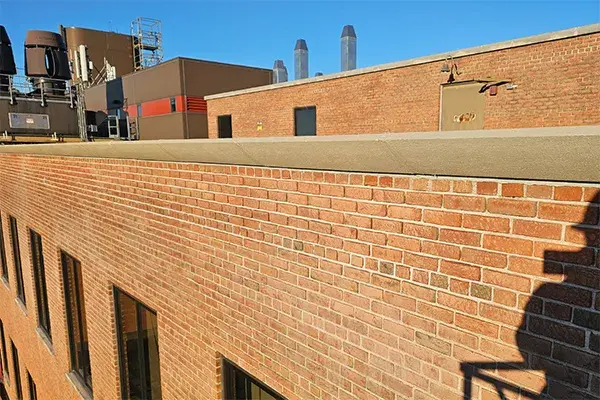
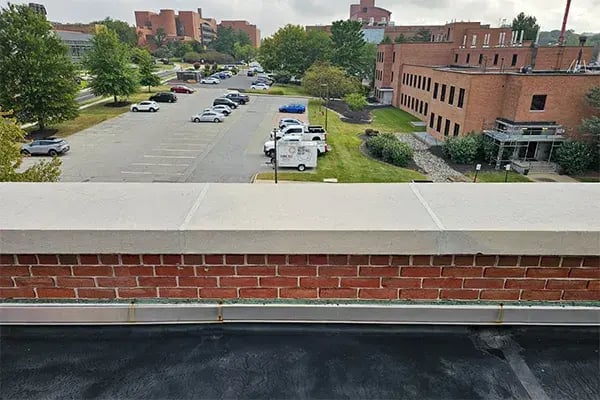
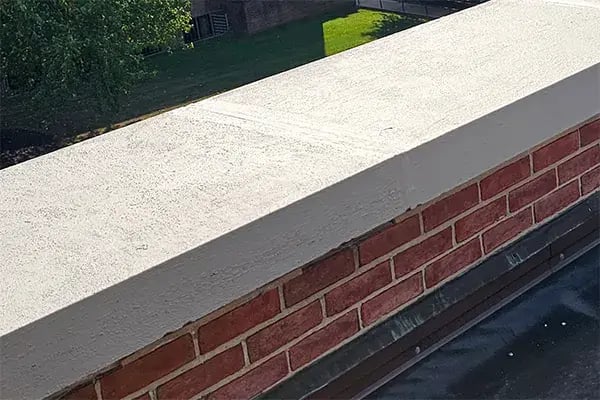
The completed system sealed the entire capstone run in a uniform Limestone Grey finish that matched the established architectural color palette of the campus’s brick buildings—an important consideration for the client. Previously open joints were sealed, bridged and reinforced, providing waterproof protection without trapping residual moisture.
By recommending repair instead of unnecessary replacement, BIG helped the facility avoid demolition, extensive scaffolding, capstone removal and landfill disposal. Encapsulation also left suspected asbestos-containing materials undisturbed, minimizing potential abatement requirements.
The result was a durable, non-invasive solution that reduced labor, cost, project time and operational disruption. More importantly, BIG corrected the existing deterioration, stopped the pathways for water intrusion and extended the parapet’s service life while preserving an appearance appropriate for the surrounding campus.
Rehabilitation work covered the parapet coping around the building footprint–approximately 760 linear feet.
The completed system delivered a continuous, monolithic weatherproof barrier over the full capstone.
Joints and seams, previously the primary path for water, are now bridged and reinforced.
Surface delamination and contour scaling of the capstone, with a cracked unit and an open, failed joint at center.
The customer requested brick pointing work along with the coating work and approved a color-matched solution.
Low-pressure washing removed dirt, biological growth and loose surface material.
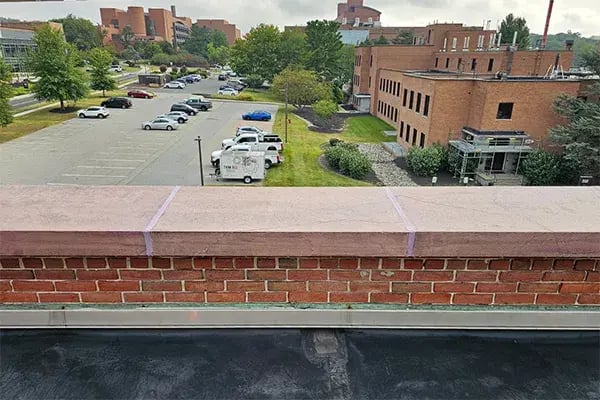
BIG rebuilt spalled, delaminated and fractured stone with Belzona 4141, profiled to match the original capstone contour.
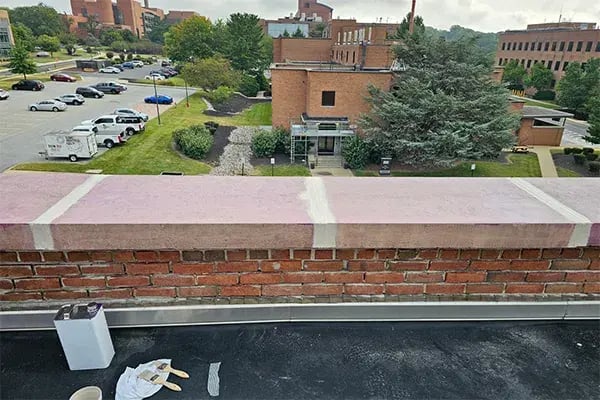
One coat of Belzona 3911 Porous Surface Condtioner stabiliized the substrate and promoted adhesion.
Joints and seams received a stripe coat of Belzona 3111 and 9311 reinforcement sheet to bridge movement at these areas.
BIG sealed the full capstone surface with two coats of Belzona 3111 tinted to the color Limestone Grey for a weatherproof finish.
The final work provides a uniform, monolithic appearance and a tough, seamless barrier over the masonry.
For more information about our capstone rehabilitation service, and other industrial solutions, please contact the Banks Industrial Group team today via email or by calling 856-687-2227.